
+86 18116360585
- English
- Chinese
- French
- German
- Portuguese
- Spanish
- Russian
- Japanese
- Korean
- Arabic
- Irish
- Greek
- Turkish
- Italian
- Danish
- Romanian
- Indonesian
- Czech
- Afrikaans
- Swedish
- Polish
- Basque
- Catalan
- Esperanto
- Hindi
- Lao
- Albanian
- Amharic
- Armenian
- Azerbaijani
- Belarusian
- Bengali
- Bosnian
- Bulgarian
- Cebuano
- Chichewa
- Corsican
- Croatian
- Dutch
- Estonian
- Filipino
- Finnish
- Frisian
- Galician
- Georgian
- Gujarati
- Hausa
- Hawaiian
- Hebrew
- Hmong
- Hungarian
- Icelandic
- Igbo
- Javanese
- Kannada
- Kazakh
- Khmer
- Kurdish
- Kyrgyz
- Latin
- Latvian
- Lithuanian
- Luxembou..
- Macedonian
- Malagasy
- Malay
- Malayalam
- Maltese
- Maori
- Marathi
- Mongolian
- Burmese
- Nepali
- Norwegian
- Pashto
- Persian
- Punjabi
- Serbian
- Sesotho
- Sinhala
- Slovak
- Slovenian
- Somali
- Samoan
- Scots Gaelic
- Shona
- Sindhi
- Sundanese
- Swahili
- Tajik
- Tamil
- Telugu
- Thai
- Ukrainian
- Urdu
- Uzbek
- Vietnamese
- Welsh
- Xhosa
- Yiddish
- Yoruba
- Zulu
- Kinyarwanda
- Tatar
- Oriya
- Turkmen
- Uyghur


A first order establishes whether a 3/8-inch digital torque wrench set fits the work. A repeat order has a different job: to reproduce that approved setup for another workstation, service team or stock replenishment. The important continuity is not simply the product name or the number of pieces in the case. It is the relationship between the wrench, its accessories and the way the set is used. A successful repeat order preserves that relationship, while making any intentional changes visible before the next kit enters service.
What Repeat Orders Should Preserve in a 3/8-Inch Digital Torque Wrench Set
There are two questions behind a repeat order: is this the same supplied configuration, and does it still suit the work? They overlap, but they are not interchangeable. An unchanged kit can be unsuitable for a new task. A revised kit can remain suitable for the old task, but only after the relevant differences have been assessed.
For a 3/8-inch drive digital torque wrench, the drive size identifies the square-drive interface. It does not, by itself, specify the torque range, accessory dimensions or digital operating behaviour. Repeating “3/8-inch” in an order therefore preserves only part of the product’s identity. The actual model and the configuration previously evaluated give that description its practical meaning.
Consider a hypothetical maintenance team adding a second station for the same operation. Reordering the established kit makes sense when it lets the second station follow the same approved method. If the new station serves a different assembly with restricted access, the old product reference becomes a starting point rather than proof of suitability.
This is the useful distinction when comparing torque wrench sets for ongoing supply: repetition should preserve an established working arrangement, not replace an application review when the work changes.
Why the Same Piece Count Can Hide a Different Kit
A kit’s piece count describes how many items are supplied, not everything those items can do. Two sets can have the same total while differing in socket coverage, accessory dimensions or the allocation of components. Matching the total therefore cannot establish that the working setup is unchanged.
Imagine that a socket in an approved setup is replaced by one with the same drive connection but a different external length. Both may connect to the wrench, yet only one may fit the available access space. The consequence is not necessarily a change in torque accuracy. It may simply be that the replacement no longer allows the previously approved setup to reach the fastener.
The distinction becomes especially important when evaluating a complete kit rather than an individual wrench. A capable torque tool cannot compensate for an absent accessory that the task requires. Equally, a larger set is not automatically a better replacement if its additional pieces do not address the actual work.
The reference also needs to distinguish supplied items from workshop additions. An accessory borrowed during a trial can make the setup usable without ever becoming part of the purchased set. Keeping that boundary clear prevents a later reorder from assuming that everything visible at the first evaluation was included in the original supply.
For repeat orders, the approved combination matters more than the headline piece count. That combination gives the manufacturer a reproducible supply requirement and gives the user a meaningful basis for comparing the next kit.
Digital Functions Are Part of Repeat-Order Consistency
The electronic functions deserve the same attention as the physical contents. A familiar case does not establish that the next wrench will be operated in exactly the same way.
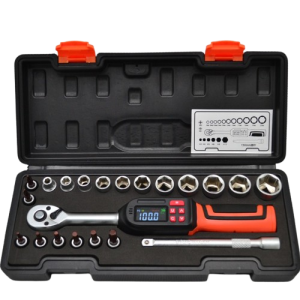
Youba’s 21-piece 3/8-inch drive digital torque wrench set combines a digital torque wrench with a set format. The product description lists selectable units, preset torque values, peak-hold and tracking modes, plus audible and visual target alerts. These are relevant to repeat supply because the approved method may depend on how an operator selects a target, reads the result and responds to the signal.
The practical issue is continuity of use, not the number of functions advertised. If a workstation instruction relies on a particular operating mode, a different interface or mode-selection sequence deserves attention even when the replacement has the same nominal drive size. Training material and the actual tool must describe the same operation.
This does not mean every interface difference makes a replacement unacceptable. It means the effect should be understood. A changed menu may require a revised instruction; a changed functional behaviour may require a targeted demonstration. The depth of review should follow the change, rather than repeating the entire original evaluation or assuming that no review is needed.
A repeat order for a 3/8-inch digital torque wrench set should therefore preserve the approved operating method as well as the contents. Where either changes, the next delivery needs an explicit transition rather than an unexplained substitution.
When Repeating the Set Is Better Than Expanding It
There is a straightforward argument for repeating an established configuration: it avoids introducing differences that serve no identified task. For a team performing the same operation at several stations, one common base kit makes the intended setup easier to describe and compare.
That argument weakens when the application changes. A new fastener-access requirement, different target torque or additional operation may justify a different accessory package or wrench. The decision is no longer simply “how many more of the same set?” It becomes “which part of the existing setup still applies?”
A useful approach is to retain the established base where it remains appropriate and treat task-specific additions separately. In a hypothetical multi-station rollout, this could mean a common kit for the shared work and an identified addition for the station with the different task. The result is deliberate variation, rather than every station gradually acquiring an undocumented mixture of tools.
There is also a limit to this approach. If an addition does not resolve the actual constraint—such as a torque requirement outside the selected wrench’s documented range—the answer is not to keep expanding the case. The tool selection itself needs to change.
The purpose of standardisation is not to make all kits identical regardless of use. It is to make sameness intentional and differences explainable. That distinction keeps repeat ordering connected to the application instead of turning it into an exercise in matching product names.
OEM Torque Wrench Sets Need a Stable Technical Core
For an OEM torque wrench set, the repeat-order discussion has both a technical and a commercial side. The tool and accessory configuration define the working product. Any agreed presentation, identification or packaging requirements define how that product is supplied under the OEM programme. A change on one side does not automatically authorize a change on the other.
For example, a packaging revision can be handled as a packaging change while the approved wrench and kit contents remain fixed. A revised accessory package, by contrast, may alter the usable setup even when the outside of the case looks unchanged. Separating those decisions helps both parties understand what is actually being repeated.
Youba manufactures industrial torque tools, including digital torque wrenches and torque wrench sets, and supplies OEM and bulk-order projects. In that context, a repeat-order specification connects the customer’s approved configuration with the product to be supplied; it is not a substitute for the manufacturer’s product offering.
The most useful technical reference is a concise definition of the approved set, supported by the relevant sample or product record. Once agreed, that reference can remain stable across successive orders, with revisions identifying deliberate changes. Specific OEM options and supply terms remain matters for the individual project rather than assumptions attached to every catalogue set.
What the Next Delivery Must Demonstrate
Repeat supply requires evidence of continuity, but not every question needs the same evidence. A contents comparison establishes whether the agreed items are present. A physical fit review addresses a changed accessory. A functional demonstration addresses an operating difference. None of these alone establishes the wrench’s measurement performance.
This distinction follows the metrology principle of verification: evidence is assessed against specified requirements. The requirement determines the relevant demonstration—not the other way around. A matching appearance answers a different question from a torque measurement result.
For a delivery intended to reproduce the approved set, the meaningful comparison is against that configuration and any accepted revisions. The reference sample helps identify the intended product; it does not prove the condition or performance of every later unit. Where the order includes instrument-specific measurement evidence, the identification and test scope need to correspond to the instruments covered.
Changes can then receive proportionate attention. An updated document can be checked against its previous revision. A different accessory can be assessed where it affects the setup. A change to the wrench’s relevant measuring characteristics belongs in the technical evaluation. Treating every difference as equally serious is no more useful than treating all differences as cosmetic.
From an Approved Set to Repeat Bulk Supply
The value of a 3/8-inch digital torque wrench set repeat order is continuity: the next kit supports the intended work without forcing the user to rediscover what was approved the first time. Product identity, accessory configuration and operating method form that continuity together.
For distributors, maintenance teams and OEM programmes, the practical starting point is the established set—not a fresh, generic supplier questionnaire. The next discussion can focus on whether the application is unchanged, which configuration is being repeated and what, if anything, needs to differ.
To discuss repeat bulk supply with Youba, reference the approved 3/8-inch set and its intended application, together with the required quantity and any planned OEM changes. This lets the quotation address a defined product configuration while keeping technical revisions separate from routine replenishment.
Previous News
Which RFQ Details Matter When Ordering a Digita...Next News
Digital Inch-Pound Torque Wrench Unit Errors: W...Feature Product
-
 XS Series Interchangeable Head Window Style Cli...
TENGTUO ELECTRONIC TECHNOLOGY Item NO...
-
 XS Series Window Style Click Torque Wrench
TENGTUO ELECTRONIC TECHNOLOGY Item NO...
-
 SL Series Interchangeable Head Window Style Cli...
TENGTUO ELECTRONIC TECHNOLOGY item NO...