
+86 18116360585
- English
- Chinese
- French
- German
- Portuguese
- Spanish
- Russian
- Japanese
- Korean
- Arabic
- Irish
- Greek
- Turkish
- Italian
- Danish
- Romanian
- Indonesian
- Czech
- Afrikaans
- Swedish
- Polish
- Basque
- Catalan
- Esperanto
- Hindi
- Lao
- Albanian
- Amharic
- Armenian
- Azerbaijani
- Belarusian
- Bengali
- Bosnian
- Bulgarian
- Cebuano
- Chichewa
- Corsican
- Croatian
- Dutch
- Estonian
- Filipino
- Finnish
- Frisian
- Galician
- Georgian
- Gujarati
- Haitian
- Hausa
- Hawaiian
- Hebrew
- Hmong
- Hungarian
- Icelandic
- Igbo
- Javanese
- Kannada
- Kazakh
- Khmer
- Kurdish
- Kyrgyz
- Latin
- Latvian
- Lithuanian
- Luxembou..
- Macedonian
- Malagasy
- Malay
- Malayalam
- Maltese
- Maori
- Marathi
- Mongolian
- Burmese
- Nepali
- Norwegian
- Pashto
- Persian
- Punjabi
- Serbian
- Sesotho
- Sinhala
- Slovak
- Slovenian
- Somali
- Scots Gaelic
- Shona
- Sindhi
- Sundanese
- Swahili
- Tajik
- Tamil
- Telugu
- Thai
- Ukrainian
- Urdu
- Uzbek
- Vietnamese
- Welsh
- Xhosa
- Yiddish
- Yoruba
- Zulu
- Kinyarwanda
- Tatar
- Oriya
- Turkmen
- Uyghur


How Should Buyers Select a Non-Digital Fixed-Value Torque Wrench for Repetitive Assembly?
A non-digital fixed-value torque wrench is not the right answer for every controlled-tightening task. It fits repetitive assembly stations where the target torque remains stable, operators should not change the setting during production, and responsibility for setting the tool is centralized. Selection still depends on the target torque, process tolerance, tightening direction, model range, square drive, socket, access envelope, setting authority and verification method. Buyers should therefore define the joint and the control process before choosing a wrench. A useful RFQ identifies the torque target, station, fastener interface, approved direction, who may set or reset the tool, how the wrench will be labelled, and what evidence is required before release to production.
When Does a Fixed-Value Tool Make More Sense Than an Adjustable Wrench?
The first decision is not whether fixed-value tools are generally better. The question is whether they fit the factory’s control strategy.
Consider a station that performs one fastening operation at one approved target for a long production run. A fixed-value wrench can reduce the opportunity for an operator to select the wrong setting. The value may be established by an authorized tool-room or calibration function, verified, identified and then released to that station. The operator receives a task-specific tool rather than a general-purpose wrench with a scale that can be changed during the shift.
The decision changes when one tool must cover several targets each day. A fixed-value approach may then require multiple preset tools, disciplined tool changes and unambiguous station identification. Depending on the number of variants, a controlled adjustable wrench or a digital system may be more practical. Changeover frequency, error-proofing requirements, traceability needs and maintenance capability all influence the result.
A fixed-value wrench therefore fits a different control strategy: it transfers setting authority away from routine production use. Buyers exploring the broader family should first compare the available mechanical torque wrench options, then decide whether a preset station tool or an operator-adjustable tool matches the process.
Separate Operator Control From Tool-Room Control
A fixed setting is useful only when responsibilities are explicit. The wrench itself cannot create process discipline if everyone can reset it, labels are missing, or verification is not tied to release status.
Operator responsibilities
- Confirm that the tool ID matches the station and joint.
- Use the approved socket and avoid unapproved adapters or extensions.
- Apply force using the instructed grip position and technique.
- Stop after the click or release event instead of repeatedly pulling the tool.
- Segregate and report a dropped, overloaded, damaged or abnormal tool.
Tool-room or calibration responsibilities
- Set the specified torque with suitable equipment and an approved method.
- Verify the tool in the required direction and within the applicable scope.
- Assign an ID, set point, station and release status.
- Control who may change the setting and retain the relevant record.
- Manage periodic checks and event-driven re-verification.
The practical chain is Setting Authority → Identification → Verification → Release to Production. If any link is missing, the words “fixed value” do not prevent the wrong wrench from reaching the wrong joint.
Which Variables Must Be Frozen Before the Tool Is Assigned?
| Variable | Buyer Must Define | Risk if Wrong | Evidence |
| Target torque | Approved value for the joint | Wrong tool assigned to the operation | Process specification or drawing |
| Tool range | Model whose stated range contains the target | Target outside the model’s applicable scope | Product datasheet and quotation |
| Direction | Required tightening direction | Accuracy or verification basis does not cover use | Product and test scope |
| Drive | Required square-drive interface | Socket mismatch or unplanned adapter | Confirmed configuration |
| Access | Clearance around the fastener and handle path | Tool cannot be operated correctly | Layout, sample or line trial |
| Set-point ownership | Authorized person or function | Uncontrolled adjustment | Work instruction |
| Identification | Tool ID, station and joint mapping | Correct tool used on the wrong joint | Label and register |
| Verification | Acceptance and recheck requirements | No objective release evidence | Test or calibration record |
The process tolerance should not automatically be copied from a tool catalogue. Joint requirements, tool performance, measurement uncertainty, production variation and the buyer’s acceptance rule are related but different. Procurement should ask engineering and quality to define the acceptance basis instead of treating a published tool accuracy value as the complete assembly capability.
Why Range Selection Still Matters for a Fixed-Value Wrench
“Fixed value” describes how the setting is controlled during use; it does not mean that one wrench can be set to any target. A product family may contain many separate models with different ranges and drive sizes. The buyer must select a model whose specified range and direction cover the required set point.
The Youba product page, for example, lists separate models spanning low to high torque rather than one universal wrench. It also states an accuracy basis in the clockwise direction from 20% to 100% of maximum torque. That statement should be read as a defined product claim, not extended automatically to another direction, an unlisted setting, or a complete joint result.
Before approval, request the exact model, stated range, maximum torque, drive, applicable accuracy statement and test direction on the quotation. If several stations use different values, map each station to a specific model and set point. This prevents the purchasing description “fixed-value wrench” from hiding important configuration differences.
Socket, Drive and Access Still Control Application Fit
The physical path remains wrench → square drive → socket → fastener → access envelope. A sound fixed-value control plan cannot compensate for a wrong square drive, unsuitable socket, excessive adapter stack or blocked handle movement.
Buyers should provide the fastener size, socket specification, available head clearance, nearby obstructions and usable handle sweep. If an adapter or extension is unavoidable, engineering should evaluate its effect and define an approved setup. A sample or line trial is especially valuable when guards, frames, hoses or adjacent components restrict access.
The objective is repeatability of the complete setup, not merely interchangeability of individual components. The released work instruction should show the approved wrench, socket and any permitted interface component as one configuration.
What Does the Click Confirm—and What Does It Not Confirm?
The click or release event indicates that the wrench mechanism has reached its release point under the way it was operated. It does not prove that the final bolt preload is exactly correct. Torque-to-preload results can also be influenced by thread condition, lubrication, coatings, joint stiffness, seating, reuse, surface condition and operator technique.
The click also does not prove that the operator used the correct joint, socket, direction or grip position. Repeated pulling after the first release can add uncontrolled input. A fixed set point reduces one source of selection error, but it does not replace a controlled fastening procedure.
This boundary matters when writing acceptance criteria. Tool verification establishes evidence about the torque tool under the defined test method. Joint validation establishes whether the complete assembly process produces the intended result. The two should support each other, but one is not a substitute for the other.
How Should a Factory Control Re-Setting and Re-Verification?
Factories need an event-based rule as well as a calendar or usage-based interval. A tool may require controlled review when the production torque changes, the wrench moves to another station, a repair or adjustment occurs, a drop or overload is reported, or an abnormal assembly result appears.
The procedure should answer four questions:
- Who may reset the wrench? Name the authorized function rather than leaving the decision to the operator.
- What verification follows? Define the test direction, set point, equipment, acceptance rule and required record.
- How is status identified? Replace or update the label so the old set point cannot remain visible.
- Who releases the tool? Separate physical adjustment from approval to return it to production.
ISO 6789 distinguishes requirements for setting torque tools and the calibration framework used for hand torque tools. Buyers should state the applicable standard, certificate or internal verification requirement rather than requesting an undefined “calibration certificate.” The required evidence depends on the quality system and contract.
How Should Buyers Evaluate the Youba Fixed-Value Wrench Family?
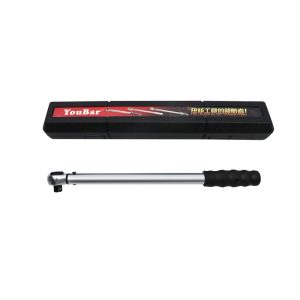
The Youba fixed-value ratchet click torque wrench page establishes a real family for evaluation. It lists multiple model ranges and drive sizes from low-torque through high-torque configurations. It states that the desired value is set with an appropriate torque tester in the tool room and that the operator cannot accidentally change the set torque. The page also publishes a clockwise accuracy statement for the specified portion of maximum torque.
These facts support a preset-tool strategy, but they do not select the correct model for a buyer. The quotation still needs to identify the model, target set point, drive, required direction, quantity per station, included socket or accessories, setting responsibility and evidence scope. Where access is uncertain, the buyer should approve the physical setup through a sample or line trial.
What Should the Final RFQ Define?
- Application: assembly, maintenance task and fastener description.
- Target torque: approved value and unit for each joint.
- Tolerance and acceptance: process requirement and review basis.
- Direction: required tightening direction.
- Model and range: exact offered wrench and applicable range.
- Drive and socket: square drive, socket size and any approved adapter.
- Access: clearance, handle sweep and obstruction information.
- Stations: number of stations and tools required per set point.
- Setting control: fixed value, who sets it and whether factory presetting is requested.
- Identification: tool ID, set-point label and station mapping.
- Verification: test, calibration, record and release requirements.
- Sample approval: trial quantity and production-line evaluation.
- Commercial scope: quantity, packaging, destination and required accessories.
Send this information through the Youba project inquiry form. Ask the supplier to return each item as Confirmed, Deviation, Alternative or Buyer Input Required. That response format makes the fixed setting, model assignment and verification boundary visible before sample approval or purchase-order release.
Frequently Asked Questions
Is a fixed-value torque wrench always better for repetitive assembly?
No. It is useful where one stable target and centralized setting control fit the station. A mixed-product line with frequent torque changes may be better served by several preset tools, a controlled adjustable wrench or a digital system.
Can the operator change the torque on a fixed-value wrench?
The production control strategy should prevent routine operator adjustment. The Youba product is intended to be set with suitable test equipment in the tool room. The buyer should still define who is authorized to reset and re-release it.
Does the click prove that the bolt preload is correct?
No. It indicates release of the wrench mechanism. Joint preload also depends on the fastening specification, friction conditions, components, process and operator technique.
What should trigger re-verification?
Follow the buyer’s quality procedure and applicable requirements. Typical review triggers include setting changes, station reassignment, repair, abnormal results, drops, suspected overload or other events that could affect performance.
Previous News
How Should Buyers Evaluate a 12-Piece 1/2-Inch ...Next News
How Should Buyers Specify a Torque Multiplier f...Feature Product
-
 XS Series Interchangeable Head Window Style Cli...
TENGTUO ELECTRONIC TECHNOLOGY Item NO...
-
 XS Series Window Style Click Torque Wrench
TENGTUO ELECTRONIC TECHNOLOGY Item NO...
-
 SL Series Interchangeable Head Window Style Cli...
TENGTUO ELECTRONIC TECHNOLOGY item NO...