
+86 18116360585
- Chinese
- French
- German
- Portuguese
- Spanish
- Russian
- Japanese
- Korean
- Arabic
- Irish
- Greek
- Turkish
- Italian
- Danish
- Romanian
- Indonesian
- Czech
- Afrikaans
- Swedish
- Polish
- Basque
- Catalan
- Esperanto
- Hindi
- Lao
- Albanian
- Amharic
- Armenian
- Azerbaijani
- Belarusian
- Bengali
- Bosnian
- Bulgarian
- Cebuano
- Chichewa
- Corsican
- Croatian
- Dutch
- Estonian
- Filipino
- Finnish
- Frisian
- Galician
- Georgian
- Gujarati
- Haitian
- Hausa
- Hawaiian
- Hebrew
- Hmong
- Hungarian
- Icelandic
- Igbo
- Javanese
- Kannada
- Kazakh
- Khmer
- Kurdish
- Kyrgyz
- Latin
- Latvian
- Lithuanian
- Luxembou..
- Macedonian
- Malagasy
- Malay
- Malayalam
- Maltese
- Maori
- Marathi
- Mongolian
- Burmese
- Nepali
- Norwegian
- Pashto
- Persian
- Punjabi
- Serbian
- Sesotho
- Sinhala
- Slovak
- Slovenian
- Somali
- Samoan
- Scots Gaelic
- Shona
- Sindhi
- Sundanese
- Swahili
- Tajik
- Tamil
- Telugu
- Thai
- Ukrainian
- Urdu
- Uzbek
- Vietnamese
- Welsh
- Xhosa
- Yiddish
- Yoruba
- Zulu
- Kinyarwanda
- Tatar
- Oriya
- Turkmen
- Uyghur


Direct answer: what makes a 1/2-inch setup compatible?
Why does the 1/2-inch drive label not prove application compatibility?
Two tools can both use a 1/2-inch square drive while serving very different applications. The socket opening may be correct but too wide externally for a recessed fastener. An adapter may connect mechanically but add unwanted length or movement. A long socket may clear a stud yet make the tool difficult to position. Even the tightening direction matters when the application requires clockwise and counter-clockwise operation.
Industrial buyers therefore need to treat compatibility as a chain rather than a single dimension. The torque wrench set category can help buyers review available set formats, but the final choice still has to be checked against the actual joint and access conditions.
| Application condition | Interface risk | Sample check | Evidence to retain |
|---|---|---|---|
| Recessed or closely surrounded fastener | Socket outside diameter or wrench head cannot enter | Fit the complete setup in the real access envelope | Photo, drawing reference and approved socket |
| Stud or deep-thread application | Standard socket bottoms out | Confirm usable socket depth and stud clearance | Socket type and fastener dimensions |
| Adapter or reducer required | Extra interface adds movement or changes geometry | Test the exact adapter chain used in production | Adapter part reference and test result |
| Extension needed for reach | Deflection, handling or access changes | Run the tightening trial with the approved extension | Extension length and configuration |
| Restricted swing arc | Ratchet cannot reset between strokes | Verify head clearance and usable operating angle | Access photo and operator assessment |
What should buyers map before selecting the wrench set?
Start with the work, not the accessory list. A distributor supplying engine service, flange work and heavy-equipment maintenance may need several socket sizes and access configurations even when every kit uses a 1/2-inch drive. The application map should identify the target fastener, socket opening, joint torque, available space, tightening direction and any required adapter or extension.
- Fastener coverage: List actual hex sizes rather than assuming that a general socket assortment covers every end customer.
- Access envelope: Record height, lateral clearance, recess depth and obstructions around the fastener.
- Tool orientation: Confirm whether the wrench can remain aligned and whether the operator has a practical pulling position.
- Direction: State whether tightening is clockwise, counter-clockwise or both.
- Interface additions: Identify reducers, adapters, extensions or special heads before the sample is ordered.
This prevents a common buying mistake: approving a set because its component count looks attractive, then discovering that the included sockets do not match the highest-volume applications.
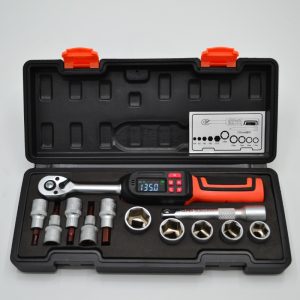
How should square drive, socket retention and included coverage be checked?
The square drive and socket must engage fully and remain secure during normal handling. Buyers should inspect engagement, retention, visible damage and excessive play on the sample. The check should use every socket size and accessory that will be included in the approved kit—not one convenient combination.
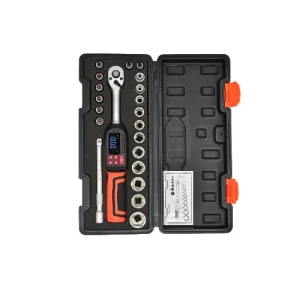
The target 12-piece 1/2-inch drive digital torque wrench set provides a concrete configuration for supplier discussion. Its listed composition should be compared line by line with the buyer’s application map. Where a different drive size better fits smaller fasteners or tighter access, the 21-piece 3/8-inch digital torque wrench set is a useful comparison—not an automatic substitute.
When do adapters, extensions or offset heads change the verification plan?
Any component inserted between the wrench and fastener changes the physical setup. Inline adapters and extensions may mainly affect reach, stiffness and handling, while an offset head can alter the effective lever geometry. The result depends on the exact arrangement, so buyers should not rely on a general statement that an accessory always does—or does not—affect the application.
If the driving center moves relative to the wrench reference geometry, the buyer should obtain the correct usage or compensation method for that configuration and verify it during the sample trial. If an extension is used only to gain axial reach, its influence still needs to be evaluated through the approved operating method, socket engagement and repeatability check. The supplier claim is not the acceptance record; the tested configuration is.
How do head length, ratchet geometry and clearance affect selection?
Clearance failures are often discovered late because buyers review drive size and torque range but omit the head envelope. A tool may reach the fastener yet leave too little room for the display, handle movement or operator’s gloved hand. Long adapters can also move the handle into a nearby frame or pipe.
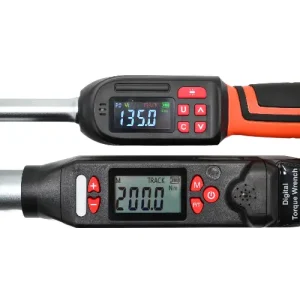
Ask for relevant dimensional information, then compare it with a drawing, fixture or physical sample of the work area. A ratchet digital torque wrench can be reviewed as an alternative configuration when buyers need to compare head and access requirements. Final suitability should be established on the intended joint.
What should an industrial buyer test before approving a bulk order?
A useful sample test reproduces the intended application instead of demonstrating the tool on an open bench. The buyer should assign the normal operator, use the planned PPE and accessories, and test representative easy, restricted and high-use joints.
| Acceptance item | Pass condition to define | Batch-control field |
|---|---|---|
| Set composition | All agreed wrench, sockets and accessories are present | Approved packing list or BOM reference |
| Mechanical fit | Full engagement and secure retention across approved combinations | Component or model reference |
| Application access | Tool reaches the fastener and can be operated without interference | Joint or station ID |
| Direction and feedback | Required direction and indicated feedback work in the trial | Test method and result |
| Verification documents | Requested documents match the supplied sample and agreed batch | Document type and serial/batch field |
| Packaging | Components remain identified and protected in transport and storage | Packaging revision |
Which compatibility fields belong in the supplier RFQ?
- Target fasteners and required socket sizes
- Joint drawings, access dimensions or clear application photos
- Required tightening direction and target torque values
- Wrench, socket and accessory drive sizes
- Every adapter, extension or offset head planned for use
- Required set composition and packaging arrangement
- Sample quantity, application test method and acceptance criteria
- Requested calibration or verification documents
- Batch labeling, identification and traceability fields
These fields make price comparisons more meaningful. A lower quotation may exclude a necessary socket, adapter, document or packaging requirement, creating a higher final cost through rework, replacement accessories or delayed approval.
Frequently asked questions
Does every 1/2-inch socket fit every 1/2 in digital torque wrench?
The nominal square-drive size may match, but buyers should still verify full engagement, retention, socket condition and application clearance on the exact combination.
Can a drive adapter be approved from its dimensions alone?
No. Dimensions are a screening check. The complete adapter chain should be tested for fit, handling, geometry and the intended tightening method.
Do straight extensions always leave the result unchanged?
Do not make a universal assumption. Confirm the exact arrangement, follow the applicable method and validate the setup during the sample trial.
When should a buyer consider a 3/8-inch set instead?
Consider it when the target fasteners, torque requirements and access conditions favor a smaller drive and head configuration. The decision should follow the application map.
What is the most important sample-acceptance test?
Testing the complete approved configuration on representative joints is more valuable than checking the wrench alone on an open bench.
Should the bulk order match the sample set composition?
Yes. Freeze the approved wrench, sockets, accessories, documents, identification and packaging requirements in the purchase specification.
Prepare the setup for technical review
For a configuration review, provide your fastener and socket list, target torque values, tightening direction, access drawings or photos, required adapters or extensions, proposed set contents, sample quantity and document requirements. Jiangsu Youba Hardware Tools can use this information to review the available configuration and prepare a sample or quotation for the intended application. Submit the project details through the technical inquiry page.
Previous News
Why Can a Digital Torque Wrench Drift Out of Ca...Next News
Digital vs Click Torque Wrench: Which Control M...Feature Product
-
 XS Series Interchangeable Head Window Style Cli...
TENGTUO ELECTRONIC TECHNOLOGY Item NO...
-
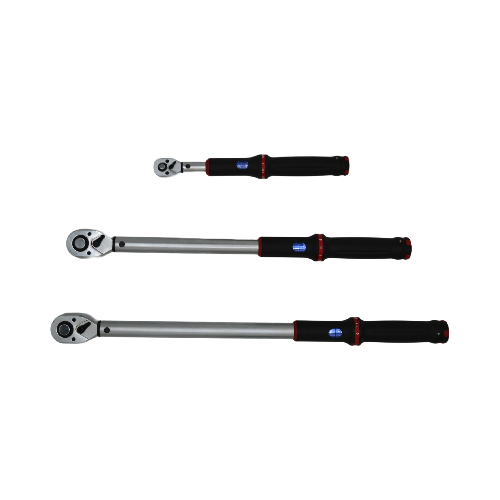 XS Series Window Style Click Torque Wrench
TENGTUO ELECTRONIC TECHNOLOGY Item NO...
-
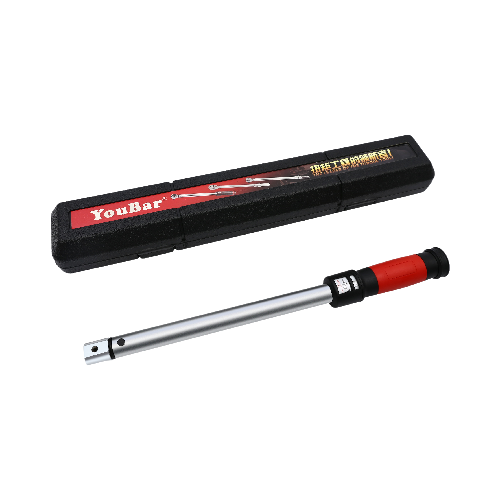 SL Series Interchangeable Head Window Style Cli...
TENGTUO ELECTRONIC TECHNOLOGY item NO...