
+86 18116360585
- English
- Chinese
- French
- German
- Portuguese
- Spanish
- Russian
- Japanese
- Korean
- Arabic
- Irish
- Greek
- Turkish
- Italian
- Danish
- Romanian
- Indonesian
- Czech
- Afrikaans
- Swedish
- Polish
- Basque
- Catalan
- Esperanto
- Hindi
- Lao
- Albanian
- Amharic
- Armenian
- Azerbaijani
- Belarusian
- Bengali
- Bosnian
- Bulgarian
- Cebuano
- Chichewa
- Corsican
- Croatian
- Dutch
- Estonian
- Filipino
- Finnish
- Frisian
- Galician
- Georgian
- Gujarati
- Haitian
- Hausa
- Hawaiian
- Hebrew
- Hmong
- Hungarian
- Icelandic
- Igbo
- Javanese
- Kannada
- Kazakh
- Khmer
- Kurdish
- Kyrgyz
- Latin
- Latvian
- Lithuanian
- Luxembou..
- Macedonian
- Malagasy
- Malay
- Malayalam
- Maltese
- Maori
- Marathi
- Mongolian
- Burmese
- Nepali
- Norwegian
- Pashto
- Persian
- Punjabi
- Serbian
- Sesotho
- Sinhala
- Slovak
- Slovenian
- Somali
- Scots Gaelic
- Shona
- Sindhi
- Sundanese
- Swahili
- Tajik
- Tamil
- Telugu
- Thai
- Ukrainian
- Urdu
- Uzbek
- Vietnamese
- Welsh
- Xhosa
- Yiddish
- Yoruba
- Zulu
- Kinyarwanda
- Tatar
- Oriya
- Turkmen
- Uyghur


A search for a 1 2 angle torque wrench usually points to a tightening procedure that involves more than a single torque target. In many controlled fastening jobs, the first step establishes a preload with torque and the second step adds a specified angular rotation. That changes the tool-selection question. A wrench that can apply the required torque may still be unsuitable for the complete process if angle measurement is not available or is handled by a separate device. For industrial buyers, the correct starting point is therefore the fastening procedure: required torque range, angle step, drive/interface, access conditions, verification method and the evidence that must accompany the tool.
Torque-Only Tightening and Torque + Angle Are Different Control Methods
Torque-only tightening ends when the required torque target is reached. Torque-plus-angle tightening adds another controlled movement after the initial torque stage. The tool or process must therefore distinguish between two different quantities: torque applied to the fastener and angular rotation after the torque threshold has been reached.
This distinction matters because the two stages are not interchangeable. A conventional click wrench may provide a clear torque event, but that event does not automatically measure the following angular rotation. A 1/2 torque wrench with angle requirement should therefore be translated into a process statement: what torque is applied first, what angle follows, and how that angle will be measured.
For procurement teams, that process definition prevents a common mismatch. A supplier can offer a mechanically suitable 1/2-inch torque wrench, yet the buyer may later discover that the actual assembly specification also requires a separate angle gauge or an integrated digital angle function.
Why the Angle Stage Changes Tool Selection
Once an angle stage is added, the buyer must decide whether the angle will be measured by the same tool or by a separate approved method. That decision affects the tool architecture, operator workflow and verification plan.
An integrated digital angle torque wrench can combine torque and angular information in one operating sequence when the product is specifically designed for that purpose. A conventional mechanical wrench paired with an external angle gauge can achieve a different workflow: one tool controls torque and another device controls angular rotation. Neither arrangement should be assumed to be universally better. The choice depends on the assembly procedure, workstation layout, operator sequence and acceptance requirements.
What Does a 1/2-Inch Drive Actually Tell the Buyer?
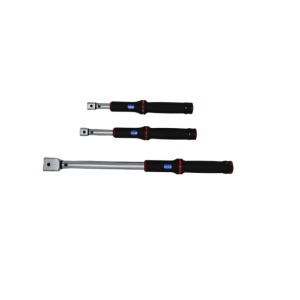
The “1/2-inch” part of a 1/2 inch digital torque wrench with angle search normally refers to the drive or downstream socket interface. It is an important compatibility parameter, but it is not a complete performance specification.
Drive size must be considered together with the socket, fastener, target torque and access space. If an interchangeable-head wrench is being considered, the buyer should also confirm how the insert head connects to the final socket or fastener interface. Youba’s current torque wrench range includes both mechanical and digital products, so the interface decision should be made at the model level rather than assumed from the keyword alone.
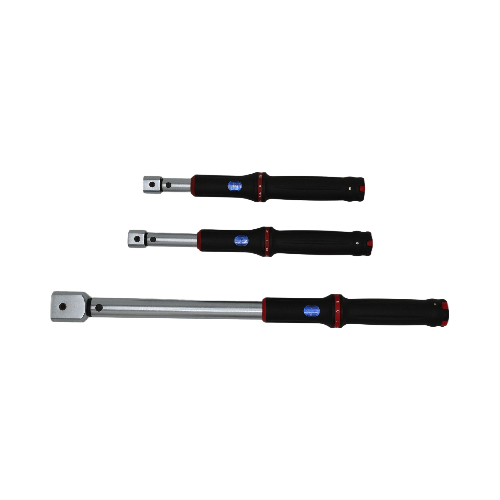
The XS Series Interchangeable Head Window Style Click Torque Wrench, for example, is documented as a mechanical interchangeable-head click wrench. Its published information gives the buyer a torque-tool reference, but it does not establish integrated angle measurement. For a torque-plus-angle process, that boundary is important: the XS Series may address the torque stage, while the angle-control method must be defined separately.
Match the Torque Range to the Real Working Window
A high maximum torque value does not automatically make a wrench a better fit. The useful question is whether the normal joints in the project sit comfortably inside the tool’s intended working range.
Before choosing a digital torque wrench with angle or a separate torque-and-angle setup, the buyer should collect the minimum, normal and maximum torque requirements across the target joints. That joint list allows the sourcing team to judge whether one wrench covers the application or whether multiple ranges are needed.
The decision chain is straightforward:
- Joint torque requirement defines the required operating window.
- The operating window determines which wrench range is relevant.
- The wrench range affects model selection and the verification/calibration evidence that should be reviewed.
- If the angle stage applies only to some joints, the angle-capable workflow may not need to be used at every station.
This is more useful than selecting from the largest published torque number alone.
Angle Measurement Needs a Defined Operating Sequence
A torque-plus-angle job should specify the operator sequence before the tool is ordered. A typical sequence may involve seating the fastener, tightening to a prescribed torque, resetting or entering angle mode, then rotating through the specified angle. The exact process is application-dependent, but the procurement team should know which steps the tool must support.
For an electronic torque wrench with angle, the buyer should verify how the operator knows the initial torque target has been reached, how angle measurement starts, and how completion is indicated. Visual, audible or vibration feedback may help, but those functions are only valuable if they fit the actual workstation.
Where angle is measured separately, the buyer should define how the gauge is referenced and how the operator avoids losing the starting position. The important point is not whether the angle method is digital or mechanical; it is whether the method can be executed consistently within the project procedure.
Torque Accuracy and Angle Verification Are Not the Same Evidence
Torque performance and angle measurement should not be treated as one combined claim. A tool can have a documented torque-accuracy statement without that statement proving the performance of an angle function. Likewise, an angle-capable tool needs evidence that the angle function operates as required for the intended application.
This matters during supplier comparison. The buyer should ask what document supports the torque specification, what operating range or direction the stated accuracy applies to, and whether angle functionality has its own verification method. The project specification may require a calibration certificate, an inspection record, or a sample verification step; the exact requirement belongs in the RFQ.
Youba’s digital products include models with stated ±2% accuracy plus buzzer and LED feedback. Those published features can support a digital torque-wrench evaluation, but they should not be extended into an angle-performance claim unless the specific product record confirms angle measurement.
When an Integrated Digital Angle Function Is Worth Specifying
An integrated digital angle function can be useful when the same operator repeatedly performs a torque-plus-angle sequence and reducing tool changes is valuable. It may also simplify the workflow where the operator benefits from having torque and angle information available on one device.
However, that does not mean every 1/2-inch application needs an integrated angle tool. If the project uses torque-only specifications, adding angle capability does not create value by itself. If only a small number of joints require angle control, a separate approved angle method may fit the process better.
The specification should therefore start with the tightening method rather than with the feature list. That keeps the RFQ focused on the work that must be performed.
Build the RFQ Around the Tightening Procedure
| RFQ Input | Why It Matters |
|---|---|
| Fastener/joint list | Shows which joints require torque only and which require torque plus angle. |
| Minimum, normal and maximum torque | Defines the real working window instead of relying on headline range alone. |
| Angle requirement | Confirms whether angle measurement is mandatory and which joints need it. |
| Drive and socket interface | Determines compatibility with the existing fastening system. |
| Head/access requirement | Controls whether the wrench can physically reach the joint. |
| Feedback method | Defines whether visual, audible or vibration alerts are useful to the operator. |
| Calibration/verification document | Clarifies what evidence must be delivered with the tool. |
| Sample trial | Allows the buyer to verify the complete torque-and-angle workflow before batch approval. |
For buyers evaluating a 1 2 angle torque wrench, the best RFQ is not the one with the longest feature list. It is the one that makes the tightening procedure explicit. Once the joint list, torque window, angle step, drive/interface and evidence requirements are defined, suppliers can respond with a configuration that can be compared on the same technical basis. Buyers can use Youba’s digital display torque wrench category as one product-discovery path and submit the application details through the project inquiry page for model-level confirmation.
Previous News
Digital Inch-Pound Torque Wrench Unit Errors: W...Next News
How to Compare Professional 1/2-Inch Digital To...Feature Product
-
 XS Series Interchangeable Head Window Style Cli...
TENGTUO ELECTRONIC TECHNOLOGY Item NO...
-
 XS Series Window Style Click Torque Wrench
TENGTUO ELECTRONIC TECHNOLOGY Item NO...
-
 SL Series Interchangeable Head Window Style Cli...
TENGTUO ELECTRONIC TECHNOLOGY item NO...